Sonderforschungsbereich
Beeinflussung komplexer turbulenter Scherströmungen

Numerical Study of Separation Control by Movable Flaps

Markus Schatz, Ulf Bunge, Holger Lübcke

Technische Universität Berlin
Hermann-Föttinger-Institut für Strömungsmechanik

Fachgebiet: CFD
Prof. Dr.-Ing. F. Thiele

Diesen Forschungsbericht gibt es derzeit nur auf Englisch

Objectives

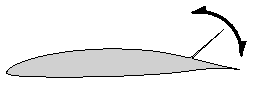
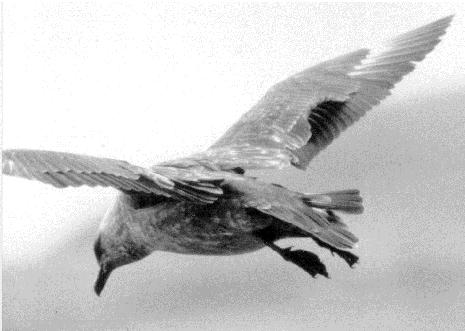
During the landing approach the feathers on the upper surface of bird wings tend to pop up, which can be interpreted as a biological high-lift device. Experimental studies of Meyer and Bechert, 1998, show that feather-like movable flaps on the upper surface of a laminar airfoil can increase lift and reduce drag at high angles of attack. For a better understanding, the effect of self-activated movable flaps is investigated by a numerical simulation of an airfoil with flap at different angles. Similar to the experiments, the numerical study considers an HQ17 airfoil at Re = 106.
HQ17 airfoil with movable flap (Re = 10^6) HQ17 airfoil with movable flap (Re=106)
Skua at high-lift condition with lifted feathers on the wing surface, 80k download
Skua at high-lift condition with lifted feathers on the wing surface
(Photo Rechenberg)
The numerical method used is based on a two- dimensional incompressible Finite-Volume scheme to solve the Reynolds-averaged Navier-Stokes equations. In previous investigations of unsteady turbulent flows, improved one- and two-equation models exhibited the best performance. Therefore, turbulence effects are modelled by the Spalart-Allmaras model as well as the LLR k- model.

1 2 3 4


Webmaster
Last modified: Wed Jul 26 19:04:03 CEST 2000